

Last Updated: October 26, 2026
Quick Summary
A no-dig waistband is a wide, flat, lightly compressive band that spreads pressure across the whole midsection instead of a narrow strip of skin. Look for a band at least 3 to 4 inches deep with no elastic strip inside and a contoured cut that rises higher in back and dips slightly in front.
- A narrow elastic core, stiff front seam, and undersized band are the three main causes of digging.
- Test the band through a roll-up, bridge, side-lying leg lift, and standing hinge without adjusting it.
- A band that digs at the sides is usually cut too straight for a curved waist.
- Higher spandex content toward 20 to 25 percent gives more compression and recovery.
- Wash leggings cold and skip the dryer because heat breaks down spandex.
Table of Contents
- Why Your Waistband Digs In (and What a No-Dig Waistband Actually Does)
- High-Waisted Pilates Leggings: Where the Waistband Should Sit
- Leggings That Don't Roll Down: Waistband Stability Under Movement
- Squat-Proof Pilates Leggings: Testing Opacity Before You Buy
- Four-Way Stretch Leggings: Stretch, Recovery, and Breathability
- Length, Pockets, and Fit: Matching Leggings to Your Pilates Routine
- Shop What If Leggings: What $44 Buys You
- Try a Pair and Test the Waistband Yourself
- Frequently Asked Questions
Why Your Waistband Digs In (and What a No-Dig Waistband Actually Does)
Most Pilates leggings dig in because the waistband is built like a rubber band, not a garment.
Digging comes from three things: a narrow elastic core that pinches, a stiff seam at the bend of your waist, and a band sized too small that has to stretch hard to stay up. Together they produce the red line, the roll-down, and constant tugging mid-class.
Here's what most guides miss: a band that feels snug in the fitting room can still dig during a Pilates roll-up.
A real no-dig band stays wide, spreads tension, and returns to shape after you move. Below are six signs that tell you, before you buy, whether a waistband will dig in.
High-Waisted Pilates Leggings: Where the Waistband Should Sit
High-waisted Pilates leggings should sit at or just above the natural waist, not across the belly button, not under the ribs.
A high rise gives coverage through forward folds and supine work, when a lower band would slide.
Watch out: a band that rides too high bunches at the ribs during side-bending, and one that sits too low slips during leg lifts. To compare rise and band styles, browse the leggings collection.
Leggings That Don't Roll Down: Waistband Stability Under Movement
Leggings that don't roll down share one trait: the band holds its shape under tension instead of folding over itself. Roll-down is a fit and construction problem, not a body problem.
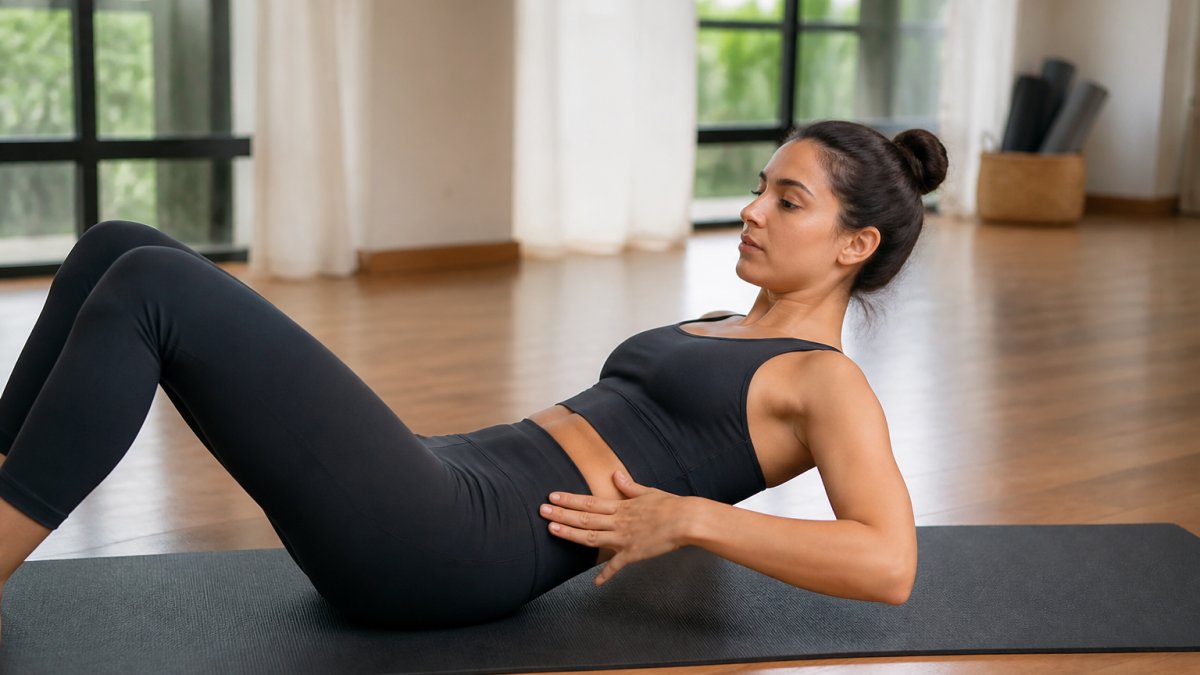
What actually causes a band to roll
Three construction failures account for most roll-down. A narrow elastic core, often a ½- to 1-inch strip sewn inside a fabric casing, concentrates tension on a thin line and folds under compression. A band cut as a straight rectangle and sewn onto a curved torso creates slack at the sides and a fold line at the front. And a seam at the natural bend of the waist gives the fabric a built-in crease to follow.
A wide, seamless or bonded band with even compression avoids all three. Look for a band at least 3 to 4 inches deep, with no elastic strip inside and a contoured cut that rises higher in back and dips slightly in front. Bonded edges, fused rather than stitched, remove the seam ridge that presses into skin during supine work.
Test it the way a Pilates class will
Standing in a fitting room tells you almost nothing. Run this sequence in order, without adjusting the band between moves:
- Roll-up: Lie supine, roll up one vertebra at a time, and pause at the top. Watch whether the front of the band creases or lifts away from the skin.
- Bridge: Press into a bridge and hold for five seconds. The band should stay level with your hip bones, not slide toward the ribs.
- Side-lying leg lift: Roll onto one side and lift the top leg. Check the side of the band for bunching, a straight-cut band will gather here.
- Standing hinge: Stand and fold forward. The band should stretch across the back without riding up or digging at the front crease.
If the band stays flat and level through all four, it will likely hold through a full class. If it creases or slides during the bridge alone, it will fail once you add reformer straps and footwork.
Pressure points and body shape
A band that digs at the sides but feels fine in front is usually cut too straight for a curved waist. Digging at the front often means a stiff front seam sits where the torso bends. Rolling at the back usually means the top edge is too loose, so the fabric slides down until it finds a fold.
Squat-Proof Pilates Leggings: Testing Opacity Before You Buy
Squat-proof Pilates leggings stay fully opaque through a deep squat, a forward fold, and a wide-legged stretch.
A fabric that looks solid on the hanger can turn sheer the moment it stretches. When knit fibers pull apart under tension, light passes through.
Watch out: black hides a lot, but thin black fabric still goes see-through when stretched hard, color is not a guarantee of coverage. If opacity is your main worry, our guide on squat-proof yoga leggings walks through testing methods and what to look for in the fabric.
Compression and opacity often travel together: a lightly compressive knit holds its shape and resists the thinning that causes sheerness.
Four-Way Stretch Leggings: Stretch, Recovery, and Breathability
Four-way stretch leggings stretch vertically and horizontally, then return to their original shape. That recovery keeps a band from sagging by the end of class, and it's the property most often described in marketing language and least often explained.
What the blend actually does
Most performance leggings pair a synthetic base, recycled polyester or nylon, with spandex (elastane) for stretch. The base fiber controls opacity, moisture handling, and durability; spandex controls snap-back. A common range is roughly 75-85 percent base fiber to 15-25 percent spandex, though the exact ratio matters less than how tightly the knit is constructed.
- Higher spandex (toward 20-25 percent): more compression and recovery, but a denser hand-feel that can trap heat.
- Lower spandex (toward 15 percent): softer and more breathable, but more prone to bagging at the knees and waist over time.
- Nylon vs. polyester: nylon tends to feel smoother and holds color well; polyester tends to wick moisture faster and cost less. Neither is automatically more opaque, knit density decides that.
Why stretch makes fabric go sheer
Opacity is a function of knit density and recovery, not thickness alone. A fabric that looks solid on the hanger can turn see-through the moment it stretches across the seat in a deep squat. A tighter knit with good recovery resists that thinning; a loose knit with poor recovery stretches and stays stretched.
Breathability and sweat management
Breathability matters just as much in a heated studio. A dense knit that blocks light can also trap heat, so look for moisture-wicking fabric that moves sweat away from skin.
A practical check: hold the fabric to a light source and look for an even knit with no thin spots, then stretch a section across your hand and see whether the color fades or stays consistent.
Care that preserves stretch and opacity
Heat breaks down spandex, so wash cold and skip the dryer to keep stretch alive longer. Turn leggings inside out to reduce pilling, skip fabric softener, it coats fibers and reduces wicking, and line dry in shade to protect both spandex and color.
Our guide on how to wash performance leggings covers the routine that preserves four-way stretch and breathability wash after wash.
Length, Pockets, and Fit: Matching Leggings to Your Pilates Routine
Full-length leggings suit mat work and cooler studios, while capri or ¾-length cuts finish below the knee and leave the lower leg free.
Pockets are a practical split. Side pockets hold a phone or key for the walk to class; a clean waistband with no pocket seams sits flatter against the midsection.
Fit comes down to size range and your measurements. Check a size guide before ordering to match rise, length, and fit to your routine rather than guessing.
| Sign | What It Looks Like | What to Do |
|---|---|---|
| Narrow elastic core | Thin band, red line after class | Choose a wide, flat band |
| Stiff front seam | Crease at the bend of your waist | Pick a seamless or contoured band |
| Band sized too small | Constant tugging, roll-down | Size up using a size guide |
| Thin stretched fabric | Sheer at seat and thigh | Test opacity in a deep squat |
| Poor stretch recovery | Bagging at knees and waist | Check spandex content and care |
| Pocket seam on band | Ridge pressing into skin | Choose leg pockets instead |
Shop What If Leggings: What $44 Buys You
Our Elite Performance Full-Length Leggings cost $44 and pair a high-rise waist with full-length coverage and side pockets.
For a shorter cut, the Elite Performance ¾-Length Leggings run $42 with the same high-rise waist and a capri length that finishes below the knee.
What you're paying for is construction: a flattering high rise, practical side pockets, and fabric chosen for movement rather than a logo. If a smooth, supportive band is what you've been missing, shop the Elite Performance Leggings for full details.

Best for: Pilates and yoga regulars who want a wide, supportive high-rise band. Skip if: you prefer a low-rise cut or a pocket-free waistband.
Try a Pair and Test the Waistband Yourself
The only real test is your own body in motion. Order a pair, do a roll-up, a forward fold, and a squat in good light, and watch the band.
At Shop What If, we build studio-quality athleisure for yoga, Pilates, and everyday movement. Our leggings combine a high-rise waist, four-way stretch fabric, and practical details like side pockets so you can move without thinking about your waistband.
Get started with Shop What If and find a pair that stays put through every class.
Frequently Asked Questions
How can I stop leggings from digging into my stomach?
Start with the band itself: a wide, contoured waistband spreads pressure across more surface area than a thin elastic strip, which is what makes a no-dig waistband work. Check that the rise sits at or above your natural waist, not across your belly, and size by your measurements rather than squeezing down a size. Compression should feel supportive, not tight. If a band leaves a red mark after 20 minutes, it is too small or too narrow for Pilates.
Are high-waisted Pilates leggings comfortable for class?
They can be the most comfortable option, provided the high rise is cut to stay put. A high-waisted Pilates legging that sits at your natural waist stays clear of the hip crease where bands tend to bunch. Look for a wide waistband with a smooth inner finish and four-way stretch fabric so the band moves with you through roll-ups and leg lifts. Avoid high rises that stop mid-belly, since those slide down the moment you hinge forward.
How can I tell if leggings will stay in place during Pilates?
Do three checks before buying. First, stretch the waistband sideways and let go: it should snap back flat without twisting. Second, hold the fabric up to a light and press your hand behind it to judge opacity, which is the same test squat-proof Pilates leggings need to pass. Third, read the fabric content; a blend with four-way stretch recovers its shape better than a thin two-way knit. Reviews that mention rolling or slipping are the fastest warning sign.
What fabric is best for Pilates leggings?
Look for a stretch knit that moves in all directions and pulls moisture away from skin, since Pilates mixes slow holds with quick transitions. Recycled polyester blends are common because they hold shape and dry quickly, and a soft inner face keeps the waistband from chafing. Breathability matters more than thickness: a dense, opaque knit can still be light. Check the care label too, because heat and fabric softener break down stretch fibers and cause pilling over time.
